Quick answer: D2C offline retail in India is shrinking because store costs are fixed while sales per store have not kept pace. SUGAR Cosmetics is shrinking its retail footprint, The Ayurveda Co has shut down, and Honasa Consumer has reworked its distributors. The brands that win next will fix online unit economics first, sell through video and creators, and open stores only where their ad data already proves demand.
For five years, “go offline” was the natural next step for every Indian D2C brand that crossed ₹100 crore in revenue. Stores signalled scale to investors. Shelves promised customers that online ads could not reach.
In 2026, that playbook is being rewritten. D2C offline retail is getting a hard reality check, and the numbers show why.
Table of Contents
What’s happening: the D2C offline retail pullback
D2C brands are scaling back offline expansion as costs rise and sales fail to keep pace, LinkedIn News reports, citing Financial Express.
| Brand | What changed |
|---|---|
| SUGAR Cosmetics | Cutting its store count to about 1,000, from around 2,400 |
| The Ayurveda Co | Shut down after raising about ₹125 crore; at peak, its founders’ brands ran 20 stores, 800 beauty-advisor counters and 10,000+ retail touchpoints |
| Honasa Consumer (Mamaearth’s parent) | Reworked its distributor network |
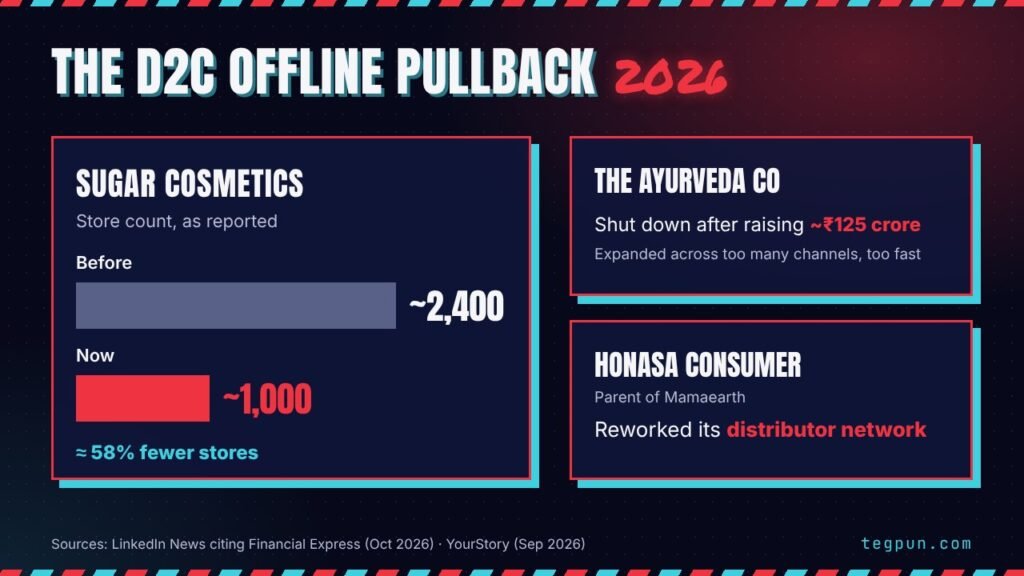
The Ayurveda Co’s co-founder Param Bhargava has said the company grew faster than the business could support, across too many channels at once (YourStory).
Alka Dembla, Head of Retail Sales at The Indian Garage Co., summed it up on LinkedIn: “Building a repeatable, profitable retail operating model is the harder part.”
Why offline retail is breaking D2C P&Ls
1. Store costs are fixed. Ad spend is not.
On Meta and Google Ads, a brand can cut spend on a bad day by evening. A store’s rent, staff and inventory cost the same whether 5 customers walk in or 500. When sales per store slow down, the fixed costs stay and the margin disappears.
2. Online customers arrive with intent. Store visitors don’t.
Someone who clicks a search ad for “vitamin C serum for oily skin” already wants to buy. Someone walking past a mall counter has to be convinced in minutes, next to three competing brands. Targeting, retargeting and reviews at the moment of decision don’t carry into a physical box.
3. Distribution eats margin and cash
General trade runs on distributor margins, retailer margins, credit cycles and returns of unsold stock. Every layer takes a cut before the brand sees revenue. That is why distributor networks are often the first thing brands restructure.
4. Too many channels, too early
Owned stores, advisor counters, distributors and thousands of retail touchpoints need systems and teams that a young brand rarely has. Each new channel adds inventory, people and reporting load before it adds profit.
5. Offline sales are invisible to your ad algorithms
Meta and Google bid using conversion data. If a customer sees your Reel and then buys in a store, the algorithm never learns that the ad worked. Brands end up underfunding the ads that drive store sales, and overfunding stores they cannot measure.
Where the growth is moving: video commerce
While stores shrink, video is becoming a key driver of online shopping in India. Amazon, Flipkart, Myntra and Meesho are investing in live commerce and shoppable video, where shoppers discover products through creators and buy without leaving the video (The Times of India, via LinkedIn News).
The early data backs it. Indian shoppers spent over 2 million hours on Flipkart’s video commerce features between June 2023 and May 2024. Tier 2 and Tier 3 regions made up 65% of that engagement, led by fashion, beauty, personal care and home décor (Outlook Business).
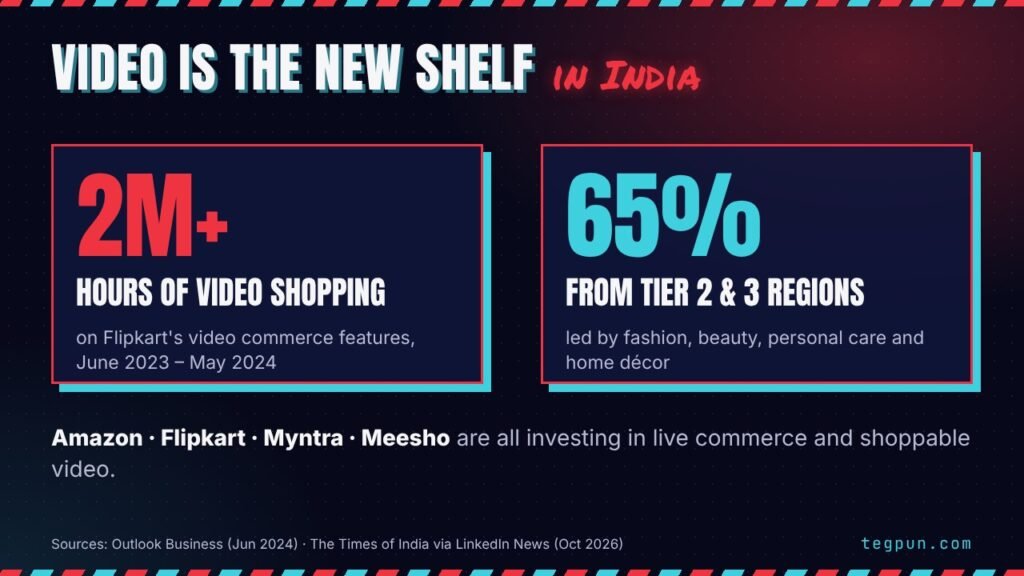
For a D2C brand, this is the discovery a store promised, without the rent. A creator video can reach a shopper in Jorhat, Indore or Nashik on the same day it reaches Mumbai.
Offline isn’t dead. It has to be earned.
Stores still work for some brands, especially in categories people want to touch, test or try. What has changed is the order: D2C offline retail should follow proven demand, not try to create it.
A store or retail push makes sense when:
- Your online business is profitable after ad spend, not just on gross margin
- Your category needs touch or trial (beauty, fragrance, apparel fit, furniture)
- Your ad data shows a city already buying from you with strong repeat rates
- You can measure store sales back to your marketing
- You have tested lighter formats first: shop-in-shops, kiosks, marketplaces and quick commerce
The playbook: an omnichannel strategy for D2C brands
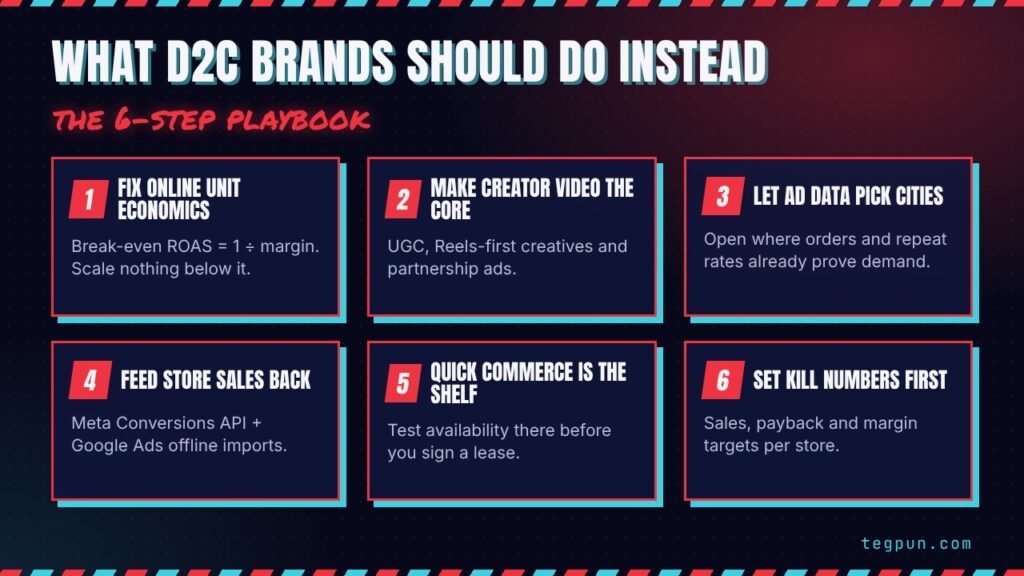
- Fix online unit economics first. Know your contribution margin after ad spend and your break-even ROAS. If your margin after product cost, shipping and payment fees is 40%, your break-even ROAS is 2.5 (1 ÷ 0.40). Scale nothing, online or offline, below that line.
- Put creators and video at the centre of your ads. Run UGC and Reels-first creatives on Meta, partnership ads with creators, and YouTube Shorts through Google Ads. Test 3–5 new video concepts a week and cut losers fast.
- Let ad data pick your offline cities. Pull orders, ROAS and repeat rate by city from Meta Ads, Google Ads and your store platform. Open a kiosk or shop-in-shop only where those numbers are already strong.
- Connect store sales to your ads. Send offline sales to Meta through the Conversions API, and to Google Ads through offline conversion imports where eligible, so both platforms learn which ads drive store purchases. This is part of how we run D2C ad accounts.
- Treat quick commerce as the new shelf. Blinkit, Zepto and Swiggy Instamart give store-like availability with variable costs and online data. Test there before you sign a lease.
- Set kill numbers before you open. Decide upfront the monthly sales per store, payback period and margin that keep a location alive, and the date you’ll close it if it misses.
At Tegpun, we use OpenAI-powered agents to track contribution margin, ROAS and city-level orders daily, so these calls are made on fresh numbers instead of quarterly reports.
What this means for D2C founders
The D2C offline retail pullback is not a sign that D2C is failing. It is a correction away from growth that looked good in a pitch deck but didn’t hold up in the P&L. The brands that win the next phase will treat every channel, whether store, marketplace, quick commerce or ads, as an investment with a number attached.
Want to see where your brand is losing margin today? Book a free 30-minute growth audit. We review your Meta Ads, Google Ads and tracking, and show you where the next rupee should go. Or explore our performance marketing for D2C brands.
I also shared my short take on LinkedIn. Join the conversation there, and subscribe to The D2C Growth Dispatch on LinkedIn for a weekly breakdown like this one.
FAQs
Why is D2C offline retail shrinking in India?
Store costs are fixed while sales per store have not kept pace. Rent, staff, inventory and distributor margins add up, and many brands expanded across too many channels before their online business was profitable.
Is D2C offline retail still worth it?
Yes, for the right category at the right time. It works best after online unit economics are proven, in cities where ad data already shows strong demand, and when store sales can be measured.
What should D2C brands do instead of opening more stores?
Fix contribution margin online, invest in creator-led video ads and shoppable video, use quick commerce and marketplaces as the shelf, and open small-format stores only where demand is proven.
How can D2C brands track offline sales from online ads?
Upload store sales to Meta through the Conversions API and to Google Ads through offline conversion imports. Matching on hashed phone numbers or emails lets the platforms credit the ads that drove store purchases.
Sources
- LinkedIn News: D2C brands rethink offline retail (October 2026, citing Financial Express and The Times of India)
- YourStory: The Ayurveda Co shuts down after raising ₹125 crore (September 2026)
- Outlook Business: Indians spent over 2 million hours video shopping, says Flipkart (June 2024)