Quick answer: The AI impact on unskilled workers will show up first in routine, screen-based tasks such as data entry, basic customer support, admin and document processing. The ILO estimates that 1 in 4 jobs worldwide is exposed to generative AI, and early payroll data shows young workers in exposed roles are already being hired less. But AI also creates new work, and people who learn to use these tools become more valuable, not less.
Artificial intelligence is moving quickly from research labs into everyday work. Companies such as Anthropic and OpenAI are developing increasingly capable systems that can write, analyze information, answer questions, create images, assist with coding, and automate routine tasks. This progress could have a significant impact on people who currently perform repetitive or entry-level work.
Table of Contents
What Anthropic and OpenAI are building, and why it matters for jobs
Anthropic makes Claude and OpenAI makes ChatGPT. Both can now draft documents, answer customer questions, summarise files, write code and, increasingly, act as agents that complete multi-step tasks on their own. That last part matters for jobs: a tool that finishes a task end to end replaces more work than one that only helps.
The companies have been open about the stakes. In May 2025, Anthropic CEO Dario Amodei warned that AI could eliminate about half of entry-level white-collar jobs and push unemployment to 10–20% within one to five years (Axios). In 2023, OpenAI researchers estimated that about 80% of US workers could have at least 10% of their tasks affected by large language models, and around 19% could see at least half of their tasks affected (OpenAI).
AI impact on unskilled workers: what the data says
| Source | Finding |
|---|---|
| ILO & NASK (May 2025) | 1 in 4 jobs worldwide is exposed to generative AI; clerical jobs are the most exposed |
| Stanford Digital Economy Lab (Aug 2025) | 13% relative drop in employment for 22–25-year-olds in the most AI-exposed jobs |
| World Economic Forum (Jan 2025) | 92 million jobs displaced and 170 million created by 2030, a net gain of 78 million |
| NITI Aayog (Oct 2025) | India could lose about 1.5 million tech-sector jobs by 2031 without action, but create up to 4 million AI jobs |
| Anthropic Economic Index (Jun 2026) | Early-career workers say AI can do the largest share of their work and worry most about job loss |
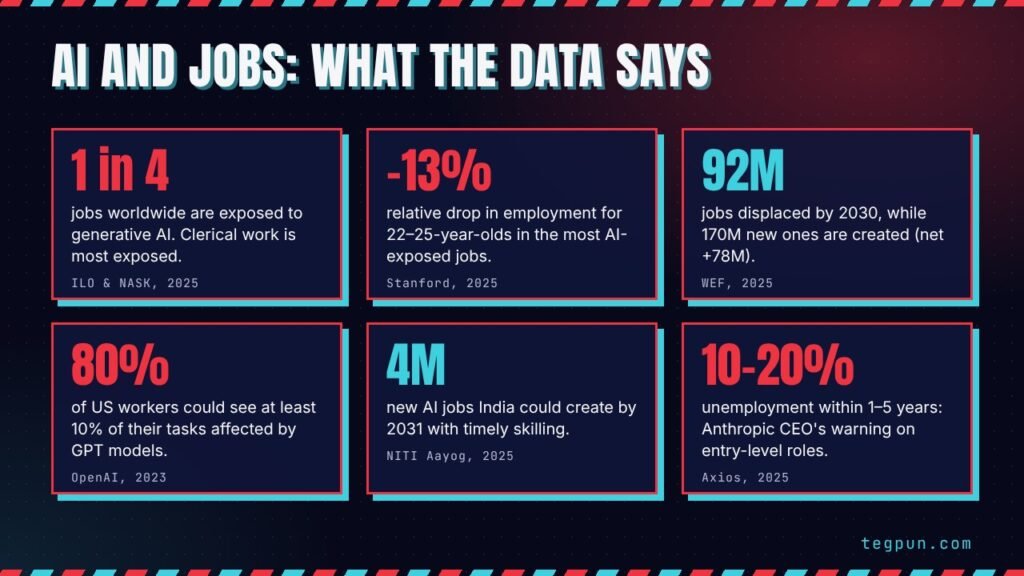
The pattern is consistent: the first jobs to feel pressure are entry-level, screen-based and repetitive. In the Stanford study, experienced workers in the same roles have so far been more stable.
Which jobs may be affected?
AI is most likely to influence tasks that follow clear patterns and require limited decision-making. Examples may include basic customer support, data entry, simple administrative work, transcription, document processing, and some routine content tasks. In many cases, AI may not eliminate an entire job immediately, but it could reduce the number of people needed to complete the same amount of work.
Roles and tasks with the highest exposure include:
- Data entry and form processing
- Basic customer support by chat or email
- Simple admin work such as scheduling and filing
- Transcription and routine translation
- Invoice and document processing
- Routine content such as product descriptions and captions
- Manual software testing, which NITI Aayog flags as highly exposed in India
Jobs that depend on physical work, such as delivery, construction, repair and care, are less exposed to generative AI for now, because these tools mainly handle cognitive, screen-based tasks.
The risks for unskilled workers
The biggest risk is increased competition for entry-level jobs. Employers may use AI tools to handle routine tasks more quickly and at a lower cost. Workers who depend on these tasks could face reduced hours, changing responsibilities, or the need to learn new skills in a short period of time.
There is also a risk that the benefits of AI will not be shared equally. People with access to education, technology, and training may find it easier to move into new roles, while others could be left behind.
The risk is not spread evenly. In high-income countries, the ILO found that 9.6% of women work in the most exposed jobs, compared with 3.5% of men, a gap linked to the high share of women in clerical roles (ILO via Nairametrics).
New opportunities created by AI
AI will not only remove tasks; it can also create new kinds of work. Businesses may need people to review AI-generated output, manage AI tools, check accuracy, protect data, provide human customer service, and perform practical work that technology cannot easily replace. AI can also help small businesses and individuals become more productive, allowing them to compete with larger organizations.
The numbers back this up. The WEF expects a net gain of 78 million jobs worldwide by 2030, and NITI Aayog estimates India could create up to 4 million AI-related jobs by 2031 with timely skilling. Many of these roles need judgement and trust more than degrees: reviewing AI output, labelling data, handling escalated customer issues and running AI tools for small teams.
This is how we approach automation at Tegpun. When we build AI agents and automation for D2C brands, the goal is to take repetitive reporting and follow-ups off the team, so people can spend more time on creative work, strategy and customers.
How workers can prepare
People do not necessarily need advanced technical degrees to benefit from the AI economy. Useful steps include learning basic digital skills, becoming comfortable with common AI tools, improving communication and problem-solving abilities, and developing expertise in a particular industry. Workers should focus on skills that complement AI rather than compete directly with its strongest capabilities.
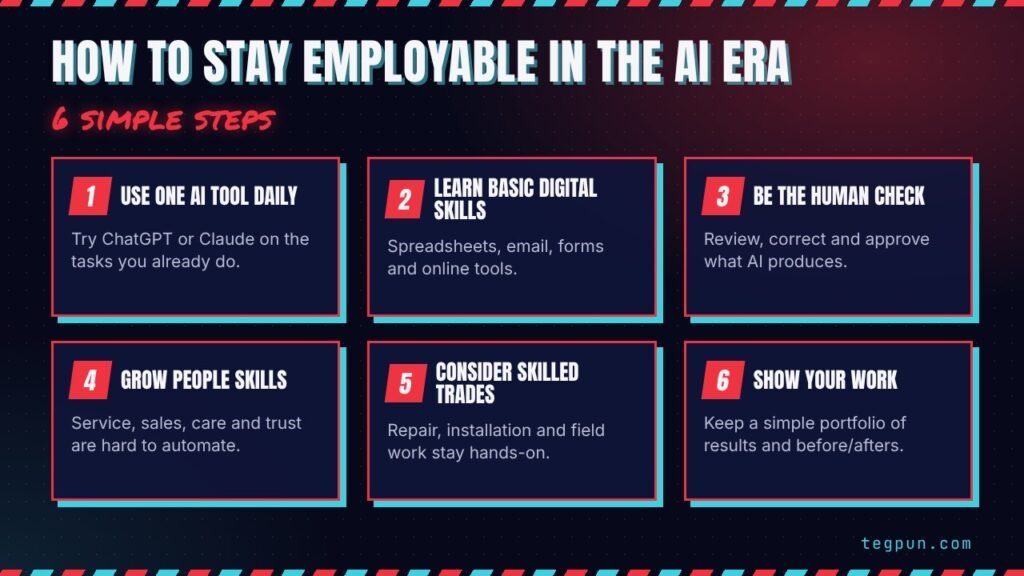
- Use one AI tool every day. Try ChatGPT or Claude on tasks you already do, like drafting emails or summarising notes.
- Learn basic digital skills. Spreadsheets, email, online forms and video calls. Free government programmes such as Skill India Digital Hub are a good place to start.
- Become the human check. Employers need people who can review, correct and approve what AI produces.
- Grow people skills. Customer service, sales, care and building trust are hard to automate.
- Consider skilled trades. Repair, installation and field work remain hands-on.
- Show your work. Keep a simple portfolio of results, even screenshots or before-and-after examples.
Practical skills, creativity, empathy, reliability, teamwork, and the ability to make sound judgments will remain valuable. Combining these human strengths with AI assistance may help workers complete tasks faster and qualify for better opportunities.
What this means for small businesses
AI also helps small businesses and individuals compete with larger organisations. A two-person brand can now run reporting, customer replies and ad monitoring that once needed a bigger team. The businesses that do best will use AI to grow output while keeping people in the roles that build trust with customers.
If you run a D2C brand and want to see where automation fits, book a free 30-minute growth audit. You can also read why D2C brands are rethinking offline retail and shifting budget to digital channels.
Conclusion
Anthropic and OpenAI are part of a broader technological shift that could make some entry-level tasks less valuable while creating new opportunities for people who adapt. The impact on unskilled workers will depend not only on the technology, but also on education, employer practices, and access to affordable training. AI may create serious disruption, but with the right support and a willingness to learn, it can also become a tool for improving productivity and opening pathways to more meaningful work.
FAQs
Will AI replace unskilled workers?
AI is more likely to replace specific tasks than entire jobs in the short term. Routine, screen-based tasks such as data entry and basic support are the most exposed, while physical, hands-on and people-facing work is less affected. Workers who learn to use AI tools can move into new roles.
Which jobs are most at risk from AI?
Clerical and entry-level office roles face the most exposure, including data entry, administrative assistants, cashiers, basic customer support and manual software testing, according to the ILO, the World Economic Forum and NITI Aayog.
Which jobs are safest from AI?
Jobs that need physical skill, on-site presence or human trust are the least exposed for now. Examples include electricians, plumbers, care workers, delivery and field technicians, and sales roles built on relationships.
How can unskilled workers prepare for AI?
Start using one AI tool daily, learn basic digital skills, become the person who checks AI output, build people skills, consider skilled trades and keep a simple portfolio of your work.
Sources
- Axios: Anthropic CEO on AI and entry-level jobs (May 2025)
- OpenAI: GPTs are GPTs (March 2023)
- Nairametrics: One in four jobs exposed to generative AI, ILO report (May 2025)
- The Register: Stanford study on AI and young workers (August 2025)
- World Economic Forum: Future of Jobs Report 2025
- Outlook Money: NITI Aayog roadmap for jobs in the AI economy (October 2025)
- Anthropic Economic Index: Cadences (June 2026)